
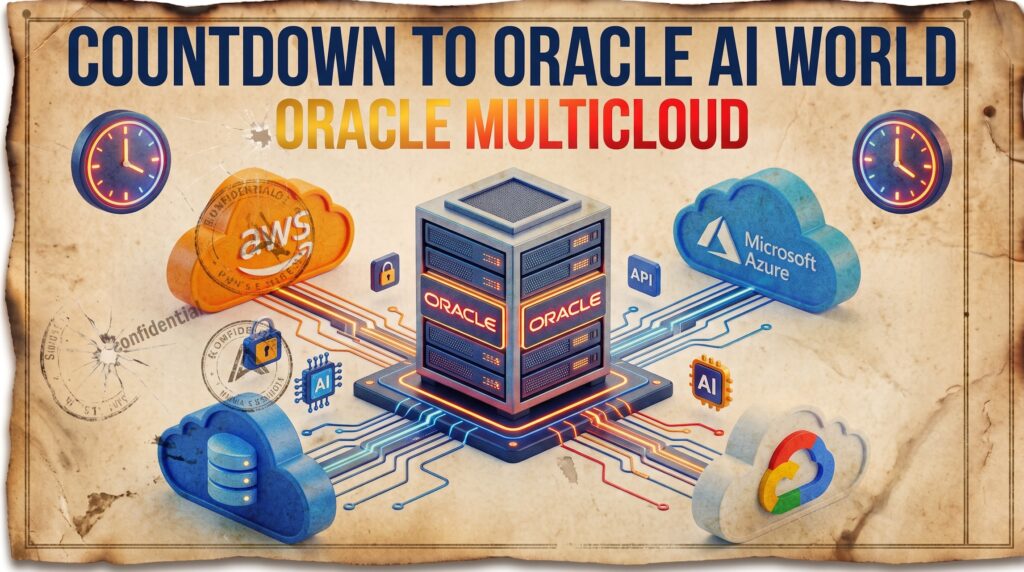
Only a week to go to Oracle AI World 2026 in Las Vegas. I thought it would be fun to write posts on what in my opinion are five impactful things in my line of work from Oracle that have really made a difference. Some of them will be bigger things while some might be more specific as well.
I’m going to start with Oracle Multicloud which has really changed my work in the past three years. Previously if you wanted to use Oracle on other clouds the options varied a lot. You had AWS Oracle RDS, Google had their own Oracle pre-built instances and Azure had some variation as well. Common for these was always that you didn’t have supported & certified way to run RAC and you didn’t have high-end option with Exadata.
This always felt like a miss and pointless discussion, as good as OCI in my opinion is (ok I’m biased), I’m also realistic it doesn’t fit for everyone!
Ever since first announcement of Multicloud solution coming to Azure around three years and following announcements to GCP and AWS, it has really changed the Oracle database landscape.
While it might be perfect option to move out from Oracle database in some cases, it’s still the one of the most solid database platforms around. The options you get in terms of features, functionality, high availability and performance are second to none.
Also, getting same functionality and performance for your existing applications might be expensive and complex! So, it might be good to continue running Oracle database either long term or use Multicloud as stepping stone for other cloud services.
What is Oracle Multicloud?
There is always confusion when we start talking about Oracle Multicloud.
First, the service runs in your clouds region/availability zone directly, it’s not link to OCI but database will reside right in there with other Azure/AWS/GCP services. Recently, Azure and AWS have also introduced support for placement groups where the Oracle database services can physically be next to your VMs for example, providing really low latency option for the most critical workloads.
Second, the multicloud services are all same database services as you get in OCI. I would say they’re 1:1 what you get in OCI in terms for functionality. This includes Autonomous Database, Exadata Database Dedicated, Exascale and Base Database. In addition there are other supported services like Autonomous Recovery Service, Golden Gate Service etc. Check the full supported list from here: https://apexadb.oracle.com/ords/r/dbexpert/multicloud-capabilities/multicloud-regions
All the features and functionality are supported similar to OCI, only difference is with Base Database which supports single node deployments only while others support RAC. Data Guard is automated similarly as in OCI etc. Things like backups, cloning, patching all are automated, you will need to schedule and manage them still yourself, exactly like in OCI.
Also, you have options, for example if your organization requires to use customer-managed encryption keys, this can be done using native Azure encryption keys or with OCI Vault.
OCI Console/Control Plane is still used for database operations, deployment for all hyperscalers is done using their console, but database operations are then done via OCI UI or API but all data is still kept within your cloud of choice.
Summary
I wanted to start this summary with Oracle Multicloud, it’s one thing that has made it possible to integrate your data with other cloud services directly where you use the services. \
It could be for example Microsoft Foundry & IQ services for agentic workloads accessing your Oracle Database or it could be moving data to Google Big Query right in the heart of that specific GCP region.
Mostly, it gives real options!